The Powers That Be: Fault Lines

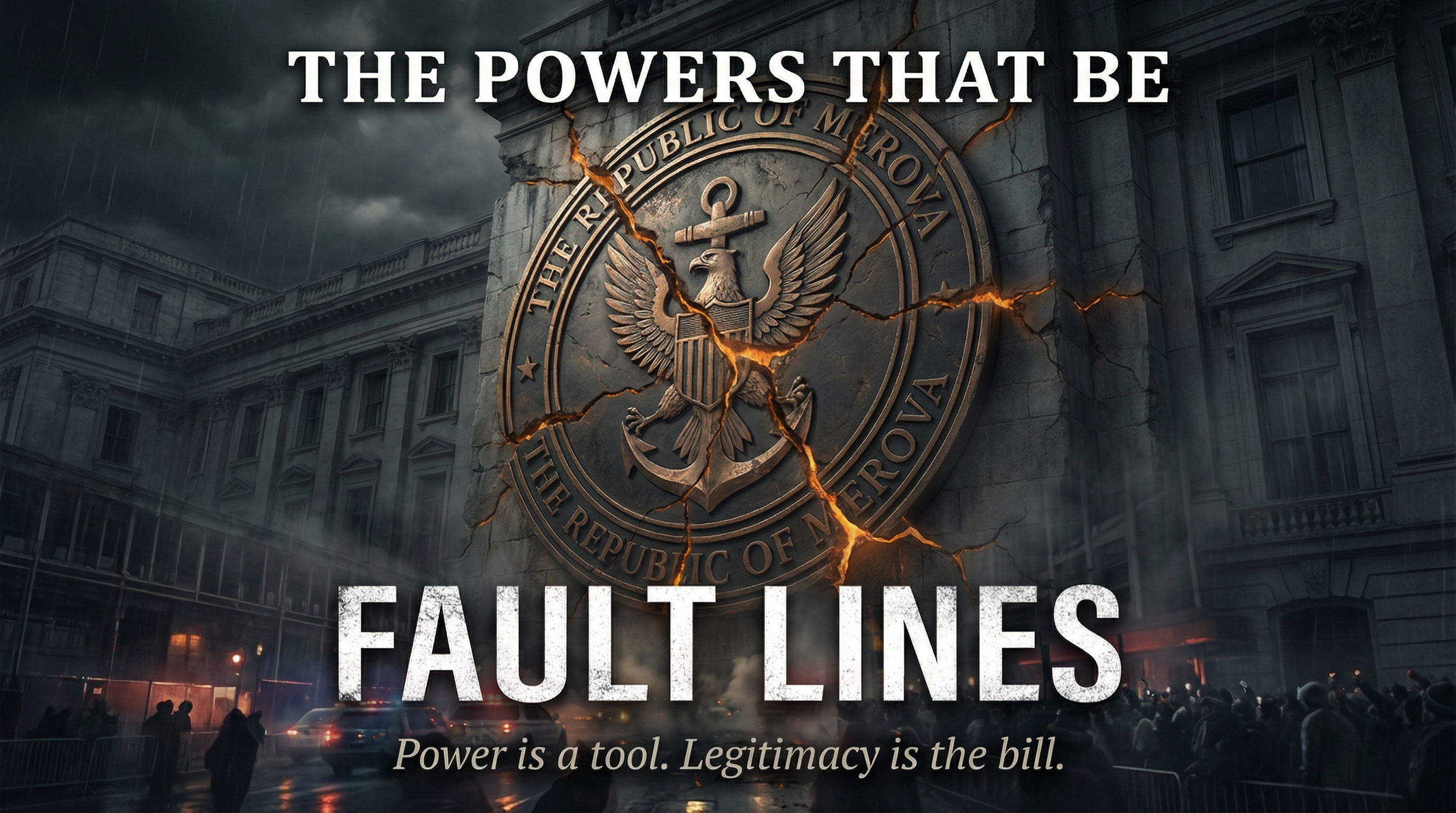
THE POWERS THAT BE:
FAULT LINES

Power is a tool. Legitimacy is the bill.

An 18+ political crisis-management simulation
[Studio Name] · 2026

Speaker Notes

This is a game about what happens when the system breaks and someone has to hold the pieces together. It's a strategy game for adults who are tired of pretending governance is simple. The first installment of a five-part franchise.

Slide 02

The strategy market has a serious gap

$15B+
Strategy market
8-12%
Annual growth
0
Serious political crisis sims

Players over 25 are underserved. Political games are either simplified (Tropico, Democracy) or abstracted into warfare (Civilization, Stellaris). No serious political crisis simulation exists.

What comparable titles proved

TitleWhat it provedWhat it didn't do
FrostpunkPlayers want moral weight in strategyCrisis is backdrop, not the system
This War of MineCivilian perspective sells (7M+ units)No institutional mechanics
Papers, PleaseBureaucratic gameplay works (5M+ units)Single-role, no systemic simulation
Crusader Kings IIIDeep political systems find mass audiencesMedieval setting, dynasty focus

The intersection — a modern political crisis sim with institutional depth and moral gravity — is wide open.

Speaker Notes

The comparable titles prove the audience exists. Frostpunk proved players will engage with moral dilemmas in strategy games. This War of Mine proved civilian-perspective stories sell. Papers, Please proved bureaucratic gameplay can be compelling. But none of them simulate the actual mechanics of political crisis — legitimacy, faction dynamics, institutional decay, and the fog of contested information. That's our space.

Slide 03

SimCity meets crisis politics

Merova at dusk

The Powers That Be: Fault Lines is an 18+ political crisis-management simulation where you play as a crisis coordinator steering a fractured island city-state through cascading institutional failure.

$29.99
Premium / No MTX
3
Platforms
18+
Age Rating
50h+
Campaign length
Turn-based strategy Crisis simulation Narrative-driven Steam + iOS + Android AI-generated cinematics
You inherit borrowed authority from the same corrupt government whose failures caused the crisis. Keep people alive. Keep institutions from collapsing. Build legitimacy. Steer a transition. Every decision costs something. There are no clean victories.
Speaker Notes

This is not a power fantasy. This is a game about the weight of responsibility. The player sits at the intersection of competing demands from six factions, 18 interlocking systems, and a city of 3.2 million people whose trust they haven't earned. The game rewards careful, long-term thinking over decisive single moves. And thanks to our AI media pipeline, every player's crisis looks different.

Slide 04

What does it feel like to play?

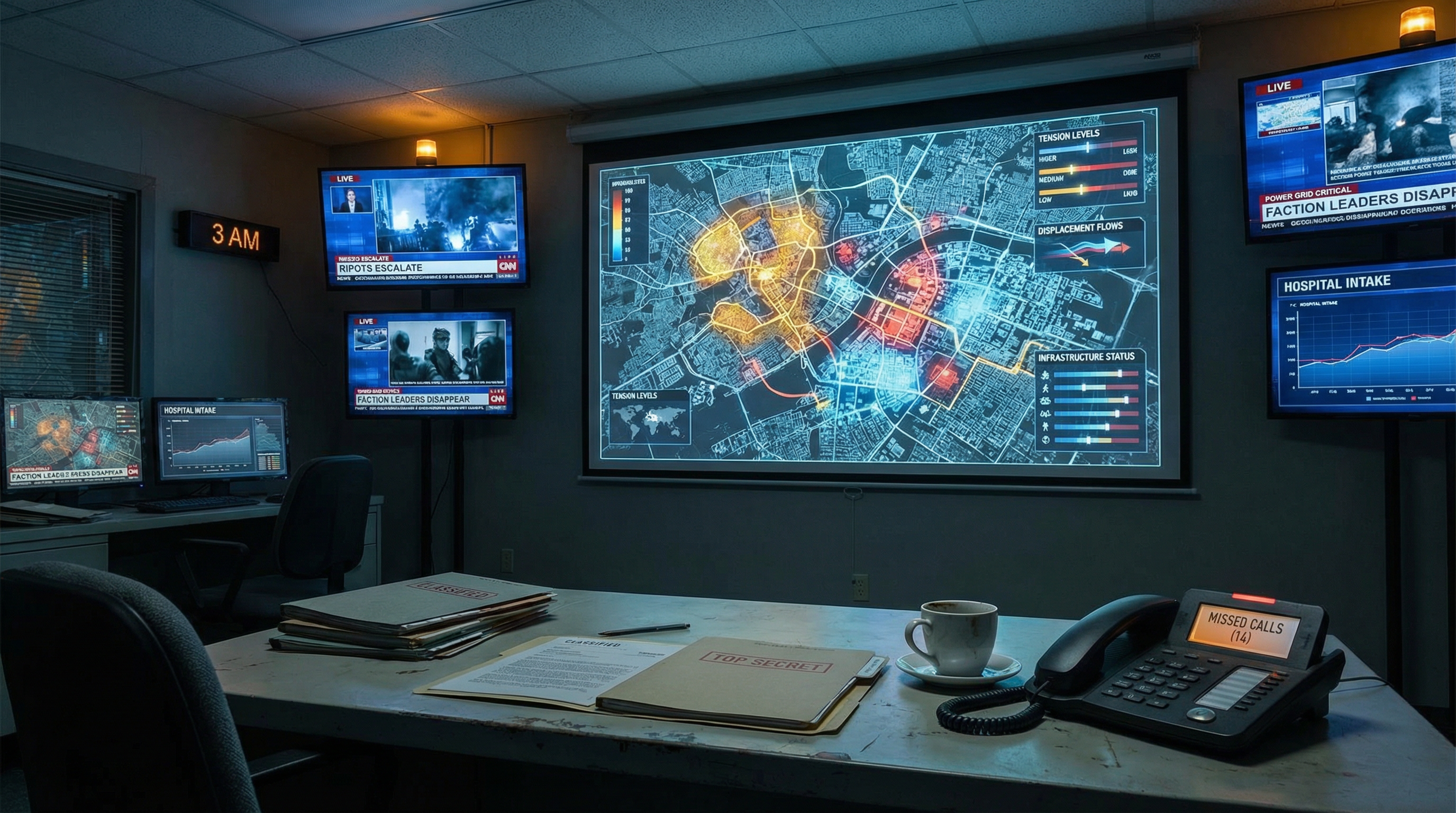
Crisis operations center at 3 AM

It's 3 AM. Your crisis dashboard shows amber across three districts.

This is not a game about having the answers

  • Fog-of-crisis: Information is partial, biased, contested, and delayed
  • Borrowed authority: Your power comes from the system you may need to dismantle
  • No right answers: Every choice creates debt somewhere else
  • Moral weight: "The player gives the order. The worldpays the price."
Speaker Notes

Walk the investor through the scenario. The player reads competing news reports, consults their crisis cabinet (3 specialized seats with different capabilities), and must decide: deploy emergency services (costs legitimacy with the labor bloc), issue a public statement (buys time but doesn't solve the problem), or investigate the corruption angle (high reward but high risk, and it takes turns to pay off). Whatever they choose, the consequences ripple through 18 interconnected meters over the next 1-4 turns. This is the core loop — and it's deeply compelling.

Slide 05

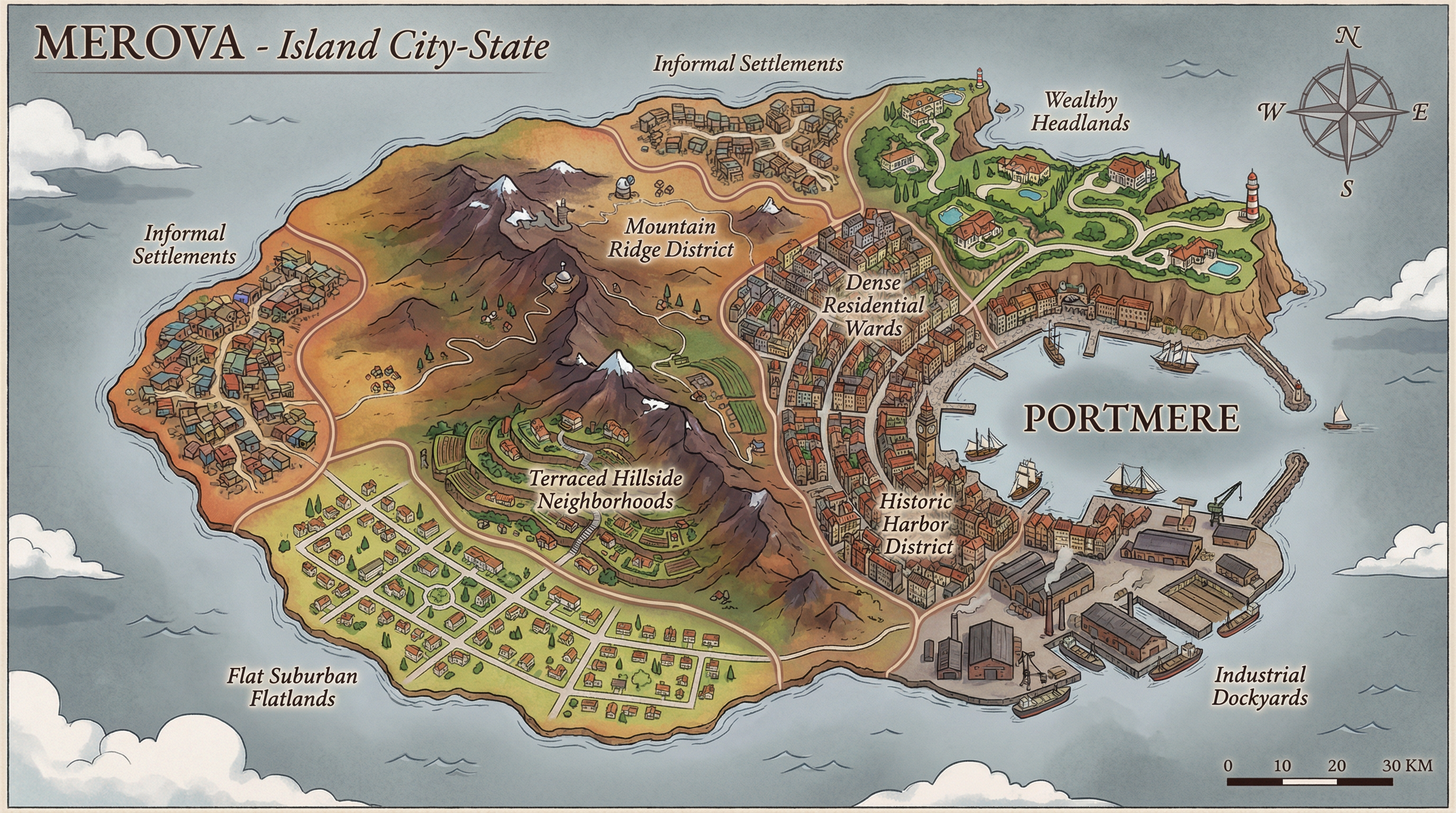
The Republic of Merova

Map of Merova

A fictional island city-state purpose-built for political crisis simulation.

3.2M
Population
3,500
km²
8
Districts
1
Island (no cavalry)

Why an island?

Design needHow the island solves it
No outside rescueClosed geography — no cavalry coming
Visible consequencesSupply ships, not abstract trade routes
Climate vulnerabilityCoastal flooding, heat domes, storms
Containable scope8 districts, not 50 states
Cultural identityDistinct but not mapped to real nations
Speaker Notes

Every design choice about Merova serves gameplay. The island is closed — there's no calling in the army or fleeing to another country. Supply chains are visible — when a ship doesn't arrive, the player can see the empty dock. Climate events hit the whole island at once. And the 8 districts create a legible map where the player can see tension spreading in real time.

Slide 06

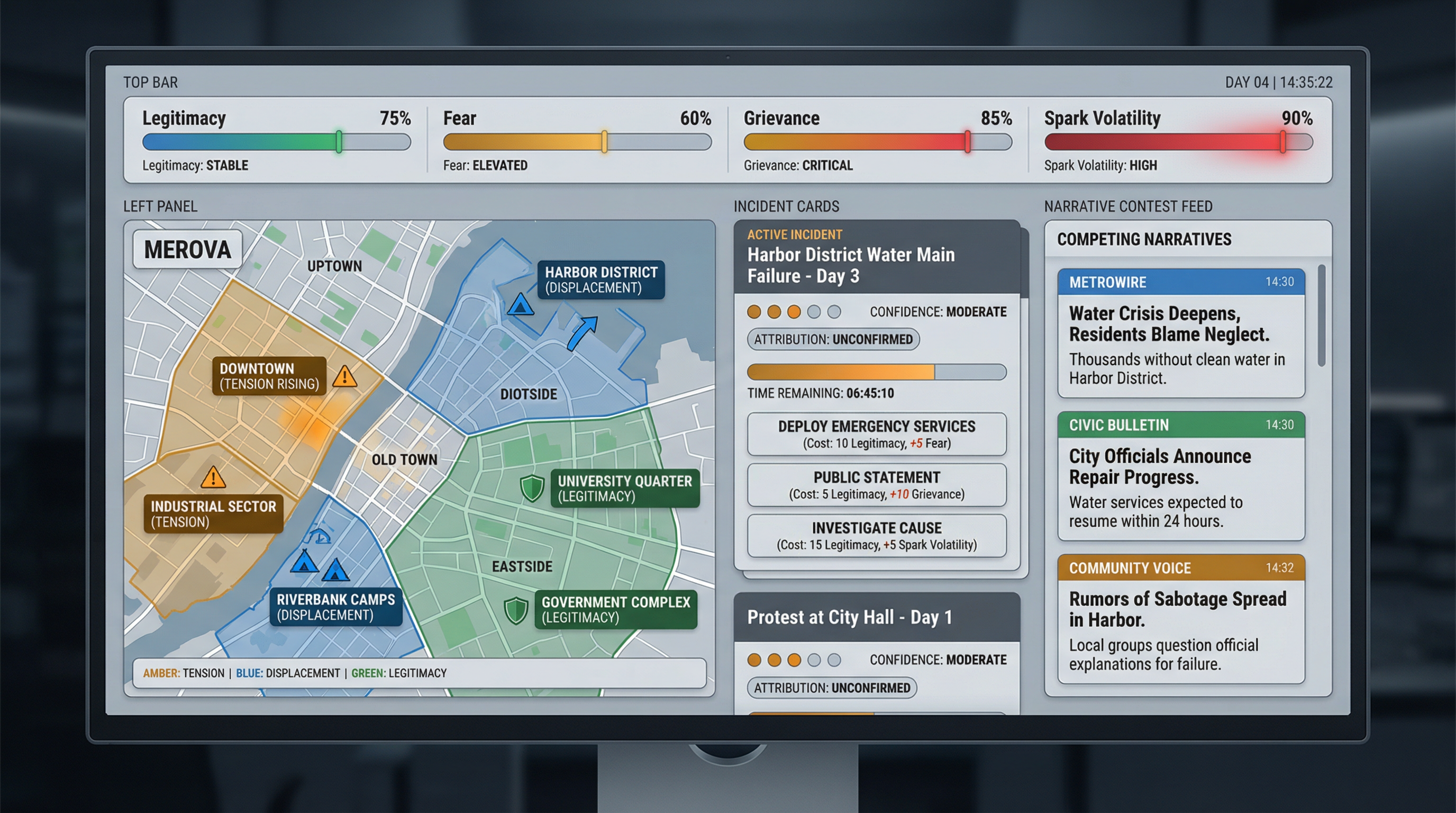
How it plays

Crisis Dashboard UI

The turn loop (1 turn = 1 week)

READ CITY STATE → 18 meters, district map, faction statusINCIDENT CARDS → 1-2 major + 3-6 minor signals per turnCHOOSE LEAD SEAT → Administrator, Public Health, or JournalistDECIDE + ALLOCATE → 1 major action + 1-2 minor actionsNARRATIVE FEED → Competing media reports, human testimonyRESOLVE + RIPPLE → Immediate effects + delayed consequences (1-4 turns)NEXT TURN → New meter states, new incidents, new pressure

18 Interlocking Meters

LegitimacyFearGrievance Spark VolatilityBlack Market Intensity Policing CapacityIntelligence Reliability Media CredibilityFaction Cohesion Faction FragmentationHumanitarian Strain DisplacementElite Defection Risk Elite Interlock IndexVigilante Activity Rights CompressionEconomic Precarity Retaliatory Pressure

6 Factions Competing for Influence

1
Civic Administration — Your institutional base (fragile)
2
Security Directorate — Police and contractors (volatile)
3
Labor Bloc — Transit, utilities, nurses (essential services leverage)
4
Community Mutual Aid — Local resilience networks (trust-rich, resource-poor)
5
Identity Populist Front — Scapegoating and rumor (exploits fear)
6
Continuity Consortium — Elite corruption network (the real antagonist)
Speaker Notes

The 18-meter system is what gives this game replayability and depth. Every action shifts multiple meters. Cracking down on protests reduces Spark Volatility immediately but raises Grievance and Retaliatory Pressure 2-3 turns later. The delayed effects are the game's signature mechanic — players learn to think in terms of debt, not just immediate results.

Slide 07

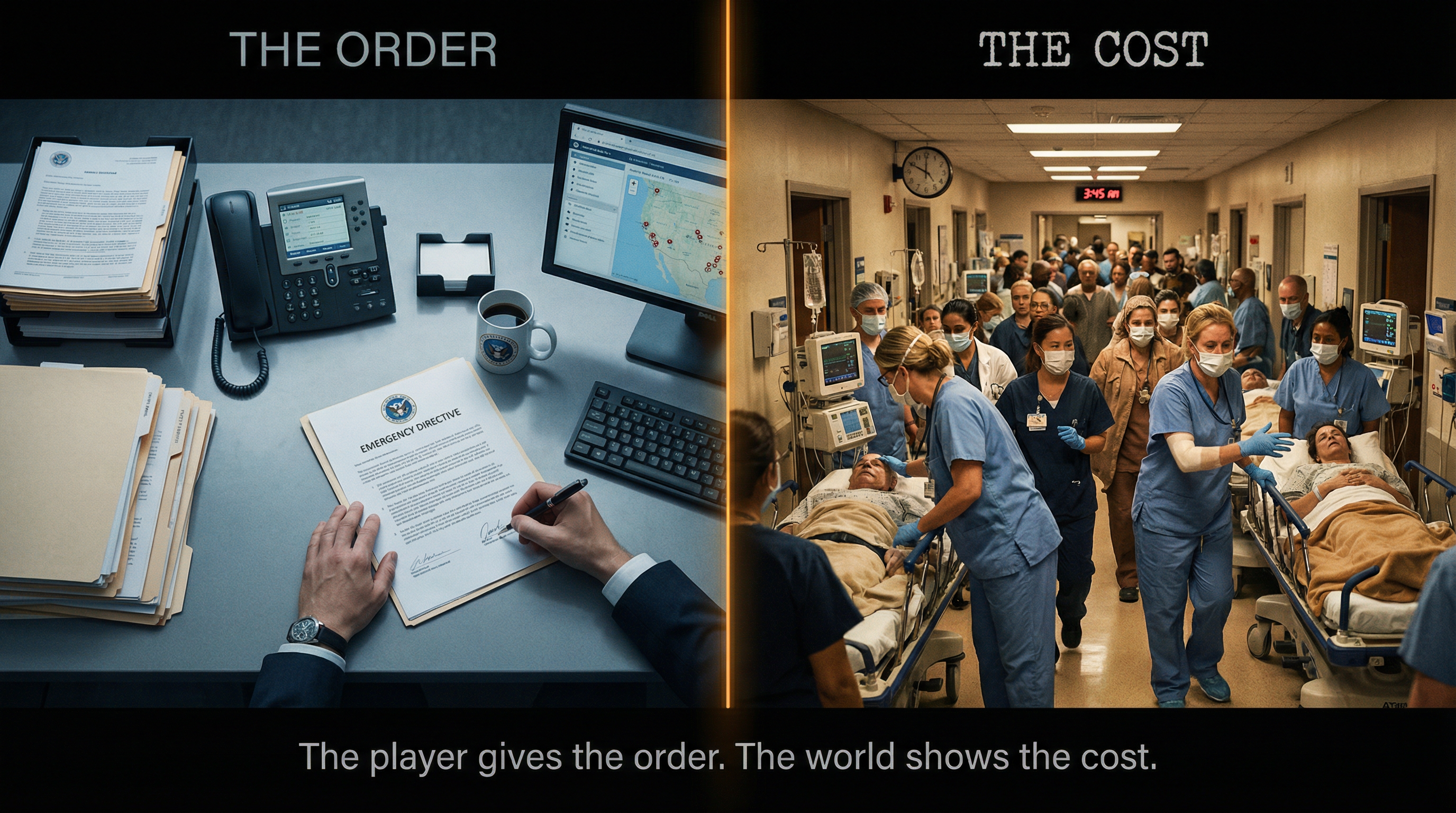
"The player gives the order.
The worldpays the price."

The Order and The Cost

This is an 18+ game. That rating is a design feature, not a marketing liability.

What the player does

  • Signs emergency directives
  • Authorizes security operations
  • Orders resource reallocations that strand communities
  • Approves media narratives that shape public perception
  • Makes tradeoffs between rights and stability

What the player never does

  • Control individual officers or combatants
  • Aim weapons or direct tactical operations
  • Witness graphic violence as spectacle
  • Receive instructional detail about conducting violence

Reference titles that prove the market

TitleHow it handles violenceSales
FrostpunkImplied through consequences$100M+
This War of MineCivilian suffering, not combat7M+ units
Spec Ops: The LineMoral weight of command decisions3M+ units
Speaker Notes

This principle is essential for both the game's integrity and its market position. We're not making a violence simulator. We're making a game about the cost of power. The 18+ rating gives us the space to show that cost honestly — a hospital overflowing because of the player's order, not a cinematic explosion. This is the same storytelling space that prestige TV occupies.

Slide 08

Every playthrough is a unique documentary film

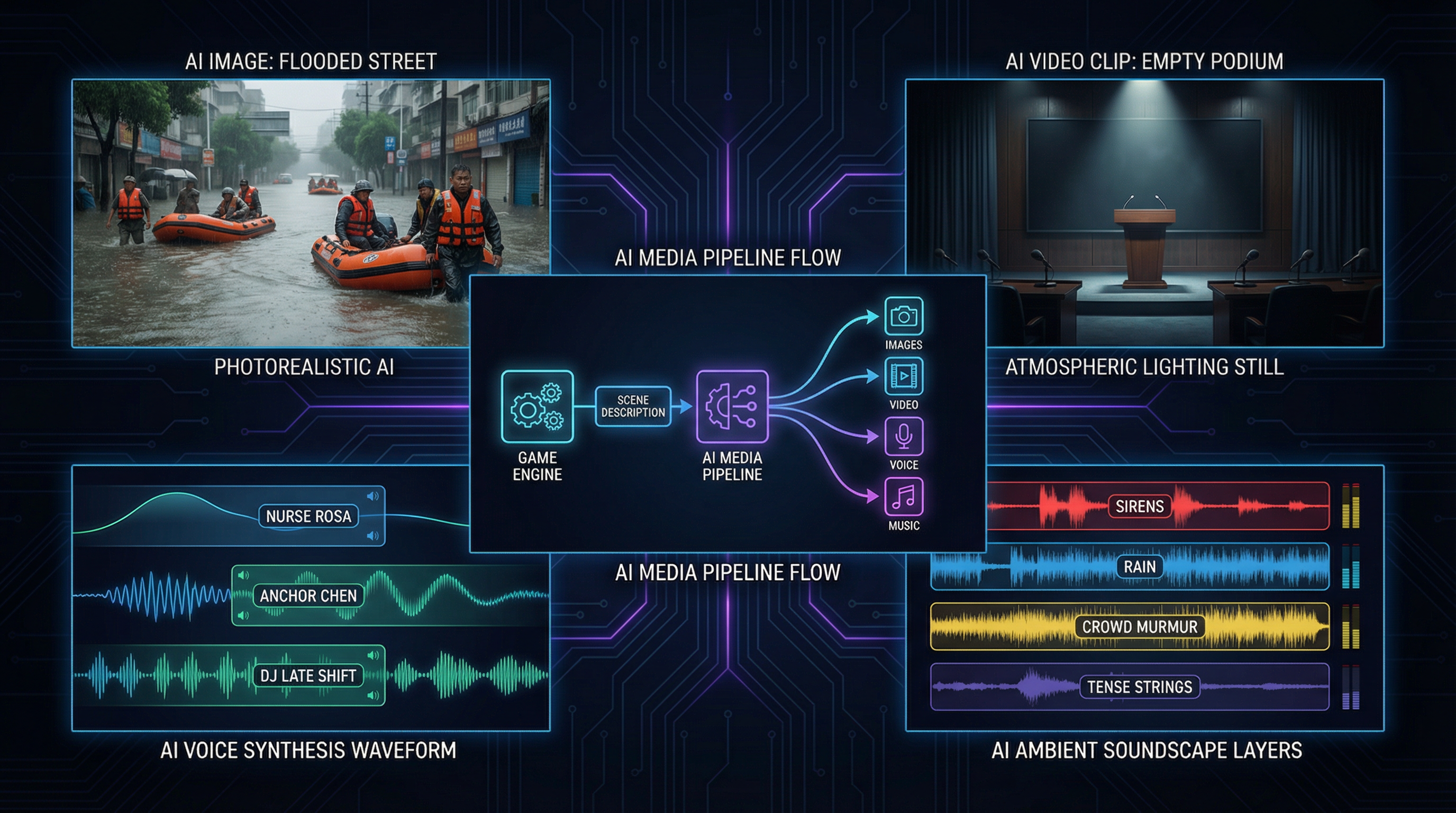
AI Media Pipeline

Our AI media pipeline generates HD images, short video clips, voiced character dialogue, and adaptive soundscapes — all unique to the player's specific crisis.

The pipeline

LayerTechnologyCostOutput
Imagesfal.ai / Stability AI~$0.04/imageEvent card art, newsfeed photos, vignettes
VideoRunway Gen-3 / Sora~$0.05-0.10/sec5-10s cinematic transition clips
VoiceElevenLabs Turbo~$0.01/line8 recurring characters with unique voices
MusicSuno V5~$0.20/trackAdaptive ambient soundscapes

Why this is a competitive moat

Cost trajectory (our tailwind)

YearImage costVideo costPer-session
2026$0.04/image$0.05/sec$2-5
2028~$0.01/image~$0.02/sec$0.50-1.50
2030~$0.005/image~$0.01/sec$0.25-0.75
Speaker Notes

This is the technology that makes this game impossible to clone quickly. The pipeline is provider-agnostic — we can swap from Runway to whatever comes next with a config change, not a rewrite. By installment 3, the media generation is essentially free. And the content is inherently streamable — every streamer produces unique footage, which is organic marketing we couldn't buy.

Slide 09

Where we sit in the competitive landscape

Deep Systems
Light Systems
Historical
Contemporary
Crusader Kings III
Civilization
Democracy 4
Tropico 6
POWERS THAT BE

Direct comparables

TitleDev costRevenueUnits
Frostpunk~$2M$100M+3M+
This War of Mine~$1M$50M+7M+
Papers, Please~$50K$15M+5M+
Crusader Kings III~$15M$100M+3M+
Democracy 4~$500K$10M+500K+

Our wedge: None of these combine modern political setting + deep institutional mechanics + fog-of-crisis + AI-generated media + franchise architecture. We're not competing with them — we're occupying the space between them.

Speaker Notes

Political strategy games either abstract politics into warfare (Civilization) or simplify it into policy sliders (Democracy). Nobody is building the systems-level simulation of how institutions actually work under pressure. Our closest spiritual comparables — Frostpunk and This War of Mine — proved the audience will pay premium prices for moral weight in strategy games.

Slide 10

Target audience

50M+
Strategy enthusiasts
30M+
Narrative gamers
10M+
Serious / political

Primary audiences

  1. Strategy / simulation enthusiasts (25-45) — already spend $30-60 on premium titles, value depth and replayability
  2. Serious game / political interest players — policy, journalism, governance, NGO professionals
  3. Narrative game audience — prioritize story and moral choice, crossover from RPGs
  4. Content creators — every playthrough generates unique AI footage, inherently streamable

Validation signals

  • Frostpunk 2 (2024): 500K units in first week
  • Against the Storm: 2M+ units, niche strategy breakout
  • Suzerain: 200K+ units for a text-heavy political sim
  • Growing "serious games" academic and corporate training market
Speaker Notes

The strategy audience is well-established and willing to pay premium. But the real growth opportunity is the crossover audience — people who watch political thrillers, read crisis journalism, and care about governance but haven't found a game that speaks to those interests. The AI cinematic pipeline makes this game visually compelling enough to reach that audience through streaming and social media.

Slide 11

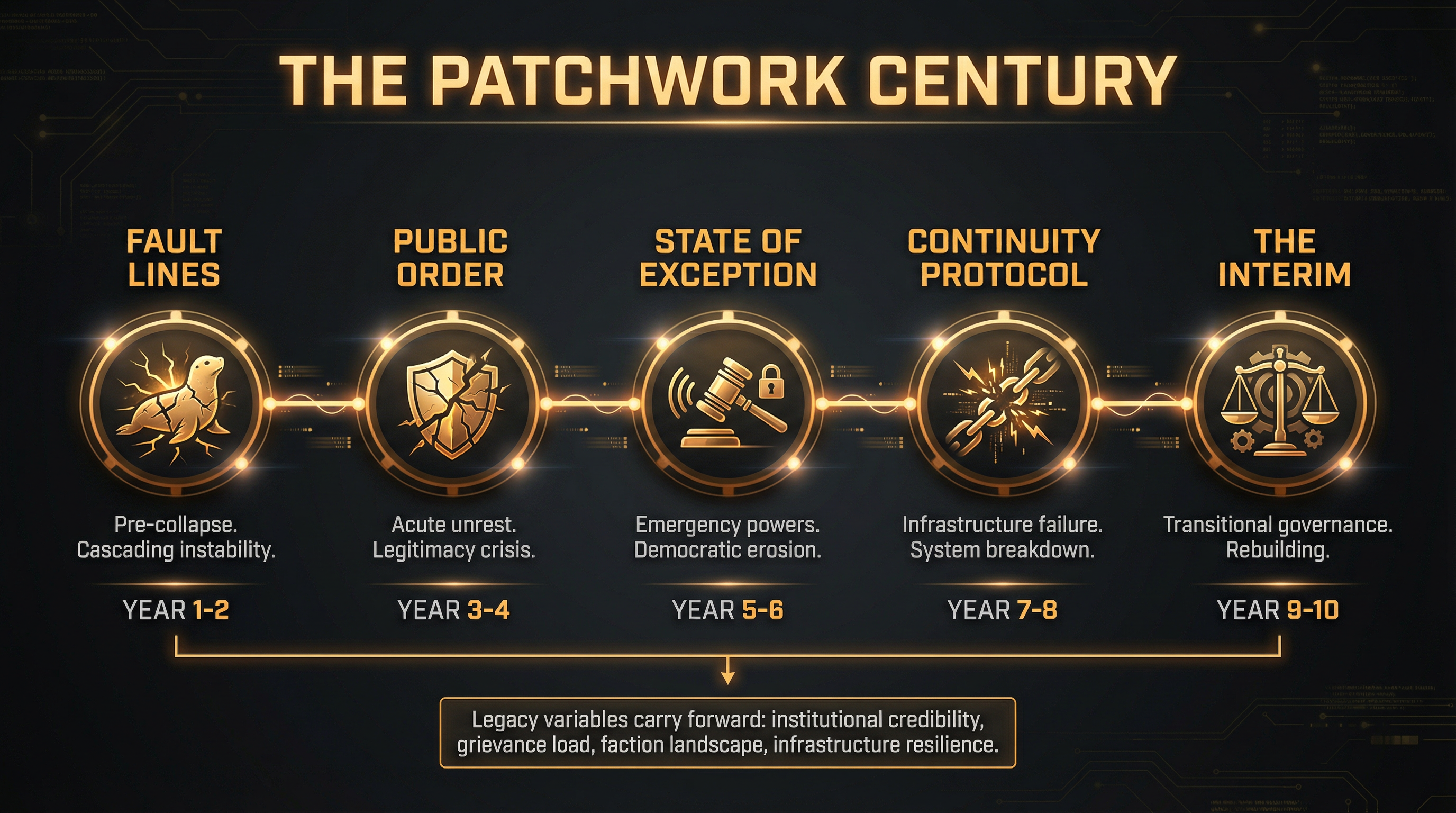
Five installments. One evolving crisis. Ten years.

The Patchwork Century franchise timeline
#TitleCrisis phasePrice
1Fault LinesPre-collapse, cascading instability$29.99
2Public OrderAcute unrest, legitimacy crisis$19.99
3State of ExceptionEmergency powers, democratic erosion$19.99
4Continuity ProtocolInfrastructure failure, system breakdown$29.99
5The InterimTransitional governance, rebuilding$19.99

Legacy system

Player choices carry forward between installments via four legacy variables:

~70% code reuse between installments. Each adds new content, not new architecture. 18-24 month cadence.

Speaker Notes

The franchise is the business model. Installment 1 builds the engine, the pipeline, and the audience. Installments 2-5 are primarily content + design work on an established platform. Development costs drop by 40-60% per installment while revenue remains comparable. The legacy system creates an emotional hook — players want to see how their Fault Lines decisions play out in Public Order.

Slide 12

Architecture designed for a 10-year lifespan

GAME ENGINE (Pure TypeScript) ├─ Deterministic: same state + action + seed = same result, always ├─ Serializable: entire game state is JSON (save/load/replay/test) └─ Franchise-extensible: new installments add data, not code rewrites CONTENT LAYER (Schema-Validated Data) ├─ All game content is validated JSON, not hardcoded logic ├─ AI can generate content; schemas catch errors before it ships └─ Community modding becomes natural (Steam Workshop) AI MEDIA PIPELINE (Provider-Abstracted) ├─ Swap image/video/voice/music providers without code changes ├─ Cost drops 50%+ annually as AI models improve └─ Pre-generation hides latency; tiered rendering ensures fallback CROSS-PLATFORM (React Native + Tauri) ├─ One codebase: mobile (Expo) + desktop (Tauri/Steam) └─ Dashboard UI is perfectly suited to React-based tech
Speaker Notes

The architecture is the real product. The engine is a pure function — given a game state and an action, it always produces the same result. This makes it trivially testable, replayable, and moddable. The content layer is data, not code. And the AI media pipeline is designed to swap providers as the landscape evolves. We're not betting on any single AI company; we're betting on the trajectory of the entire industry.

Slide 13

Business model

Revenue projections — Fault Lines (Installment 1)

MetricConservativeModerateOptimistic
Units (Year 1)50,000150,000400,000
Revenue (Year 1)$1.0M$3.2M$8.5M
Lifetime units150,000500,0001.5M
Lifetime revenue$3.0M$10.5M$30M+

Based on $29.99 price, 70% net after Steam/App Store fees, standard indie strategy sales curves.

Revenue streams

  1. Game sales — $29.99 base, $19.99 expansions
  2. Franchise installments — 5 releases over 10 years
  3. AI media credits — optional extended play credits
  4. Educational licensing — university courses, corporate training
  5. Content creator partnerships — streamer-friendly design

Unit economics per session

Cost itemPer sessionPer campaign
AI images (25-35)$1.00-1.40$5-7
AI video (3-5 clips)$0.75-2.50$4-12
AI voice (15-25 lines)$0.15-0.25$1-2
AI music (1-2 tracks)$0.20-0.40$1-2
Total AI cost$2-5$10-25
Gross margin (after AI + platform)~55-65%
Speaker Notes

The conservative case assumes we sell comparably to Democracy 4. The moderate case assumes Suzerain-level awareness with better production values. The optimistic case assumes breakout comparable to Against the Storm. AI costs are manageable at premium pricing and decrease over time. The franchise model means even the conservative case is profitable by installment 2.

Slide 14

5-person core team + specialist network

Full-time (seed-funded)

RoleResponsibility
Creative Director / Game DesignerVision, systems design, balance, content pipeline
Lead EngineerEngine, architecture, AI media pipeline, CI/CD
Frontend / UI DeveloperReact Native UI, dashboard, map, cards, accessibility
Narrative DesignerDilemmas, vignettes, newsfeed, tone bible, SME coordination
ProducerSprints, milestones, stakeholder comms, community

Contract specialists

RoleEngagement
Art Director / Visual ArtistHeavy months 1-6, periodic after
Sound DesignerMonths 8-14
QA LeadPart-time → full-time months 13+
Political Science SME3-4 review cycles
Sensitivity Readers2-3 full content passes
Legal CounselIP, content rating, privacy, ToS

Why 5 people can build this

Speaker Notes

The team structure is lean by design. The architecture is specifically built to amplify a small team through AI tools. The engine being pure TypeScript with strict types means AI coding assistants are highly effective. The content being schema-validated JSON means a narrative designer can create game content without writing code.

Slide 15

7 phases, 24 months to launch

Phase 1: Foundation
Mo 1-3
Phase 2: Engine
Mo 4-7
Phase 3: AI Media
Mo 8-11
Phase 4: Platform
Mo 12-14
Phase 5: Content
Mo 15-19
Phase 6: Release Prep
Mo 20-22
Phase 7: Launch
Mo 23+

Key milestones

MonthMilestoneDeliverable
3Engine proof-of-concept18 meters functional, type system complete
7Playable vertical slice10-turn "Heat Debt" scenario, placeholder art
11Cinematic demoSame scenario with AI-generated media
14Platform betaSteam + mobile builds, community infrastructure
19Content complete32+ dilemmas, 6 seats, 5+ scenarios
22Release candidateFull QA, store submissions
24LaunchSteam + App Store + Google Play
Speaker Notes

The timeline is aggressive but achievable. The design documentation is already mature — we're not starting from a blank page. The 18-meter system, incident pipeline, dilemma catalog, and setting bible are all designed and validated. Phase 2 is the critical risk gate — if the vertical slice plays well with placeholder art, the rest is execution.

Slide 16

Seeking $750K – $1.5M seed

Use of funds (18-month runway at $1M raise)

CategoryAllocationAmount
Engineering (3 FTEs)45%$450K
Art + Audio (contract)15%$150K
AI Media Credits10%$100K
Operations (legal, infra, tools)10%$100K
SME + QA (contract)10%$100K
Marketing (pre-launch)5%$50K
Reserve5%$50K

What the money buys

Return scenarios (Fault Lines only)

ScenarioLifetime unitsLifetime revenueROI on $1M
Conservative150K$3.0M3x
Moderate500K$10.5M10.5x
Optimistic1.5M$30M+30x

Franchise installments 2-5 are additional revenue at lower development cost.

Speaker Notes

We're seeking enough runway to reach a visually compelling demo by month 11. That demo serves double duty: it's the basis for early access and press coverage, and it's a fundable milestone for follow-on investment if we want to extend the runway. The 45% engineering allocation reflects that this is a tech-first studio.

Slide 17

We've thought about what could go wrong

RiskSeverityMitigation
Content sensitivityHighViolence principle baked into design. Sensitivity readers. Content warnings + intensity toggles. No real-world mapping.
AI cost overrunMediumProvider abstraction. Cost tracker with budget caps. Tiered rendering degrades gracefully. Costs trending down 50%/year.
AI provider shutdownMediumNo single-provider dependency. Fallback static art library. Self-hosted models as future option.
Scope creepHigh18-meter system is bounded. Content is data, not code. Month 7 vertical slice is the scope gate.
Platform riskMediumSteam is primary (mature 18+ policies). Mobile launch can follow desktop.
Audience too nicheLowFrostpunk ($100M+), TWOM (7M+ units) prove mass-market appetite. AI media expands accessibility.
Key-person riskMediumArchitecture maximizes AI-assisted dev. Pure TypeScript with 100+ tests. Straightforward onboarding.
Speaker Notes

The biggest risk is content sensitivity — but we've been designing for it from day one. The violence principle, the coordinator POV, the 18+ rating, and the content warning system are all part of the design, not afterthoughts. The second biggest risk is AI costs, which we mitigate through architecture and the fundamental cost trajectory of the industry.

Slide 18

Three converging trends create this window

1. AI costs are collapsing

Image generation: $0.50 in 2023 → $0.04 in 2026 → projected $0.01 by 2028. The cinematic pipeline was economically impossible 2 years ago. First-mover advantage: we build the architecture now; the economics improve every year.

2. The audience is proven

Frostpunk 2, Against the Storm, Suzerain have validated the market. "Prestige TV for games" is emerging with no dominant player in political simulation. Strategy audience on Steam grew 15% in 2025.

3. The indie toolchain is mature

Expo + Tauri + TypeScript = cross-platform from a single codebase. AI coding assistants provide 3-5x productivity for well-typed codebases. Managed services eliminate infrastructure overhead.

A 5-person team in 2026 can ship what required 20 people in 2020.
Speaker Notes

The timing argument is essential. Two years ago, the AI media pipeline would have cost $50-100 per session — non-viable. Two years from now, someone else will have built it. The window is now.

Slide 19

Where this goes in 10 years

Crisis coordinator's desk at night

The Patchwork Century becomes the definitive political crisis simulation franchise.

Games have explored war, survival, civilization-building, and fantasy politics. Nobody has built the game that explores how institutions actually work under pressure — how legitimacy is built and lost, how information is contested, how corruption adapts, how well-intentioned people make terrible tradeoffs.

That game is The Powers That Be.

Power is a tool. Legitimacy is the bill.
Speaker Notes

Close with the vision. This isn't just a game — it's a new genre. Political crisis simulation doesn't exist yet as a category. Frostpunk opened the door to "moral weight in strategy." We're walking through it. The franchise architecture, the AI pipeline, and the design maturity give us a 2-3 year head start over anyone who tries to follow.

Slide 20

Let's talk.

What we need

  • Seed investment ($750K - $1.5M)
  • Strategic advisors with gaming industry experience
  • Introductions to the serious games community

What we offer

  • Mature, validated game design (18 months of design work)
  • AI-first competitive moat
  • 5-installment franchise, 70% code reuse
  • A category-defining product

[Name] · [Email] · [Website]

Appendix available

Full design document (50+ pages) Technical architecture spec 10-turn playable scenario Setting bible (Merova) Violence principle docs
Speaker Notes

Leave them with the appendix offer. The depth of the design documentation is itself a signal of seriousness. Most pitches at this stage have a concept and a prototype. We have a complete design system — 18 meters with cross-effects, 14 incident types, 12 dilemma templates, a full setting bible, and a technical architecture. The engineering risk is execution, not design. That's a much better risk profile for an investor.